 Loading... Please wait...
- Call us on Phone 213.936.5599
- Gift Certificates
- Wish Lists
- My Account
- 0.00

Categories
Articles - norris
CHUCK NORRIS ONE-ON-ONE INTERVIEW
Posted by Jose M. Fraguas on Nov 26th 2016
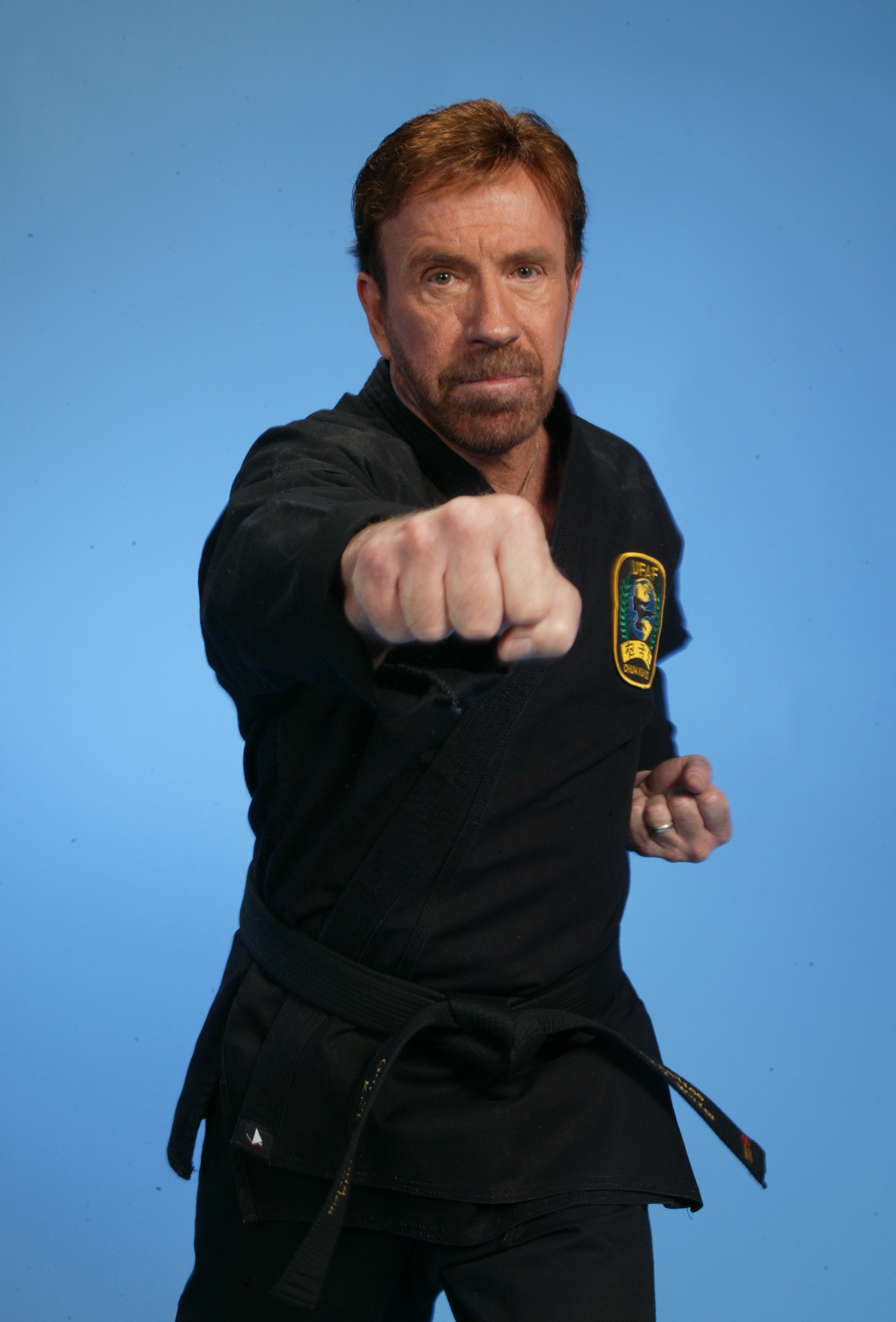
Carlos Ray Norris began training in tang soo do in Korea in 1960, while in the Air Force. After returning from Korea, Norris began teaching and also training, learning from such world-class masters as Fumio Demura, Tsusomu Oshima, and Hidetaka Nishiyama. His reputation in the point-tournament karate circuit grew quickly. He became a world champion in 1968, and retired undefeated several years later. His determination to win led Norris to defeat every major competitor of his time with the exception of Mike Stone. After dropping out of tournament competition, Norris made a name for himself in Hollywood, becoming one of the biggest action stars in the world. His fight scene against Bruce Lee in The Return of the Dragon, in the final scene, has been described as the best martial art fighting sequence of all time. At his 30th birthday party at a Chinese restaurant, his fortune cookie read, "Success should be a result, not a goal.” When asked about his great success, he answered, "It just happened. I never planned it.”
When did you decide to choose acting as a career?
I was teaching Steve McQueen and he said that I should try acting. He thought that I had a presence that would be believable on the screen. I knew that nobody could fill Bruce’s shoes as far as martial arts on the screen, but I felt that I could do something else that would work for me.
Did you ever expect the kind of success you had?
To be honest I’ve never thought about it. As a karate practitioner I never was expecting to became a world champion – it just happened. I don’t think you ever visualize these kinds of things. You work in a certain direction and you set realistic goals. Those things give you the chance to reach higher levels.
Do you feel comfortable being a star?
I don’t look at myself as a star, so I don’t take it seriously. In the movie business you’re up and you’re down – it depends on a lot of things. That’s why success, for me, means to be happy with your life and to be healthy. Money can’t guarantee you happiness. I know a lot of very rich people who are very, very unhappy.
Have you ever compared yourself to Steven Seagal, Jean Claude Van Damme, or other action stars?
I never felt like I had to be compared to anyone else – I do the best I can within myself. It’s the old martial arts philosophy that the only person I’m competing against is myself. So, I don’t waste my energy looking outward.
It is true that you began teaching karate in your parent’s backyard?
Yes, it is. I did it because I had to support my family and there were no schools around. After that I opened a small school in Torrance, California. So when I was waiting to go into the LAPD, I decided to make my living teaching karate. I quit my job and opened a second school in Redondo Beach and began competing in tournaments. A little bit later I opened another school with my friend Bob Wall in Sherman Oaks.
Why did you two decide to split?
We were planning to go nationwide so we sold our schools to a big corporation. It just didn’t work out, for whatever reasons, and Bob went into real state and I went into films.
Who were the toughest competitors you ever fought in point tournaments?
Skipper Mullins, Joe Lewis, Ron Marchini, and Steve Sanders.
You mentioned once that you had a very good story about Skipper Mullins.
Yes, I do. It was Sunday night at the 1968 Grand Nationals. The next day I was going to make a movie with Dean Martin and I had to face Skipper Mullins in the finals. Skipper always left a mark on me. I might win but I was always bruised. Anyway, I went to him and said, "Skipper, don’t hit me in the face, I have to do a movie tomorrow.” He said OK. We bow in and the first thing he did was to fake a round kick, like he used to do all the time, but this one really hit me in the eye. As soon as I felt it, I knew it was going to swell. So when he was leading by three points he began to running out of the ring to use up time. I went to him and said, “Why you don’t stay in the ring and fight like a man?" Boy, his pride got hurt. He didn’t run out again and I end up beating him! Afterwards, I told him that he was stupid. If he would have kept doing the same thing, he would have beaten me!
Did you mind losing?
Yes, but as long as you learn from your mistakes you do OK. The only time you ever lose at anything is when you don’t learn from the experience. Any experience, good or bad, is really not a failure.
What your opinion on ranks?
Rank was never a big deal for me. Many people have been trying to exploit their ranks for years.
What does it take to become a champion?
I believe there are three important aspects. First, you have to be in excellent physical shape – the top shape you can possibly be in. Then there is the mental aspect – intellectually, you have to know what to do at the right time. And the last aspect is your emotional balance – your psyche.
You were one of the first practitioners to train under different teachers. Why?
Well, I realized that I had to pick up things from different instructors to enhance my fighting ability. That’s why I trained under Fumio Demura, Tsuomu Oshima, Hidetaka Nishiyama, et cetera. To be honest, I think that was key that made me win. I was trying to unify their teachings under a system that would work for everyone. Fumio Demura was a very big influence in my life. He taught me a lot of things.
What did you name your system?
Chun kuk do.One day I was trying to figure out what my system was, because it definitely wasn’t tang soo do, anymore. My system is a mixture of many methods. In Korean it means "universal system," because that’s what I wanted to be, an all-encompassing system.
Have you always had an open-minded approach to the arts?
I’ve always believed that when you’re close-minded you stop learning. My martial arts training began in the Korean styles, but I also studied Japanese karate, Chinese kung fu, et cetera. I had no problem with learning different arts.
What do you think about fighters today?
They’re more versatile. When I competed they were more stylized – they used to fight according to their styles. Anyone who could adapt a technique to a different style had an edge. Today, all the fighters are very well-rounded because they have seen and trained in several systems. They can adapt very easily and they have the understanding to refine what works and what doesn’t in competition.
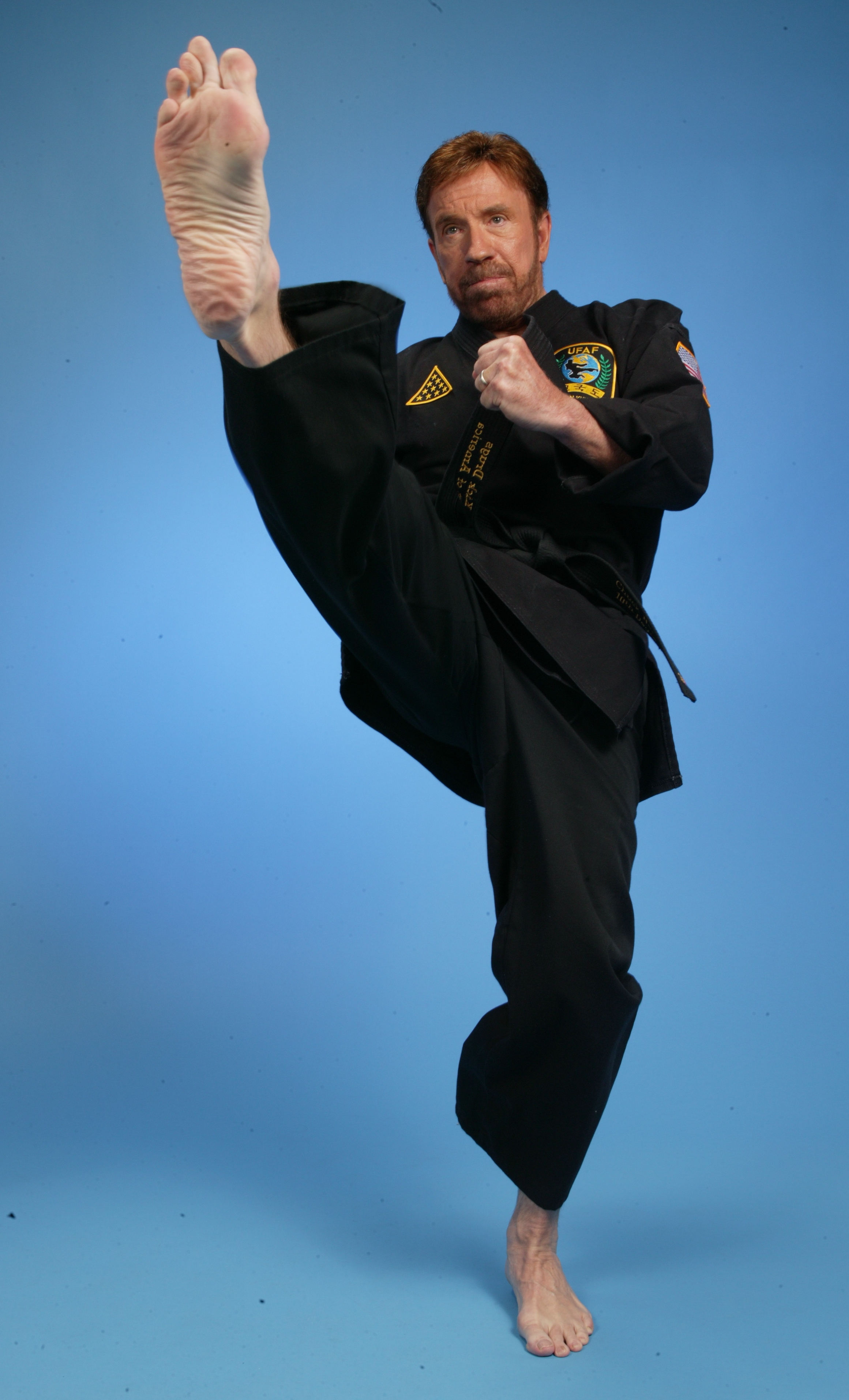
You have also been involved in the grappling arts.
Well, being a friend with Gene LeBell is a great thing. I’ve also had a lot of training in Brazilian jiu-jitsu under the Machado brothers.
How did you meet the
Machados?
My good friend Richard Norton was talking a lot about his jiu-jitsu training,
and he convinced me to go with him once and I really enjoyed it. That’s why I
decided to introduce Machado jiu-jitsu into my federation. Fighting on the
ground is a whole different game and I wanted my UFAF instructors to get
involved with the Machado system of jiu-jitsu.
So you recommend grappling?
Of course! Punching and kicking are great, but many times you end up on the ground where your punches and kicks are no longer useful. To me this is not something new. I’ve been involved in judo and jiu-jitsu since the sixties. But I was fortunate enough of meet the Machado brothers, who have a more refined version that can be used on the street.
Do you follow any particular diet?
I believe in moderation in your eating habits. If you have to deprive yourself, then when you go off the diet, you’ll put the weight back on.
Why didn’t you get involved with full contact karate?
For me, full contact kickboxing is a second cousin to true martial arts. There is nothing wrong with it, but it is a professional sport and not an art and philosophy.
How do you maintain a regular training schedule, being so busy filming?
It’s hard – sometimes very hard. I like to do my cardiovascular training early in the morning, when I also do my flexibility training. For my kicking training, I do a lot of rehearsing so I kick a hundred times everyday. I used to weight train with Lou Ferrigno but my work schedule changed so much that I had to adapt. I still training with weights as my schedule allows. For me to be in shape – to be in good physical condition – is more important that kicking or punching 1,000 times everyday. I’m not competing anymore so my goals are different. Priorities not only change in life but in training, too. The body is like an engine. Keep it finely maintained and tuned and you won’t have problems with it. Just keep a high level of conditioning.
How did your training change after you got involved in movies?
You have to look for different things. When you’re competing, all the training goes to the techniques you’re going to use in the ring. But now, in my case, I have to be in good shape, I mean the look of my kicks has to be developed equally because of the camera angles. I have to be equally developed on both sides of my body – so in a sense I’m a better martial artist for it.
What kind of training did you do when you had more time?
On Monday, Wednesday and Friday I used to do weight training with Lou Ferrigno. And then on Tuesday, Thursday, and Saturday I used to do all the cardiovascular training with karate punches and kicks for over an hour and a half. Then the treadmill, rowing machine, speed bag, and heavy bag.
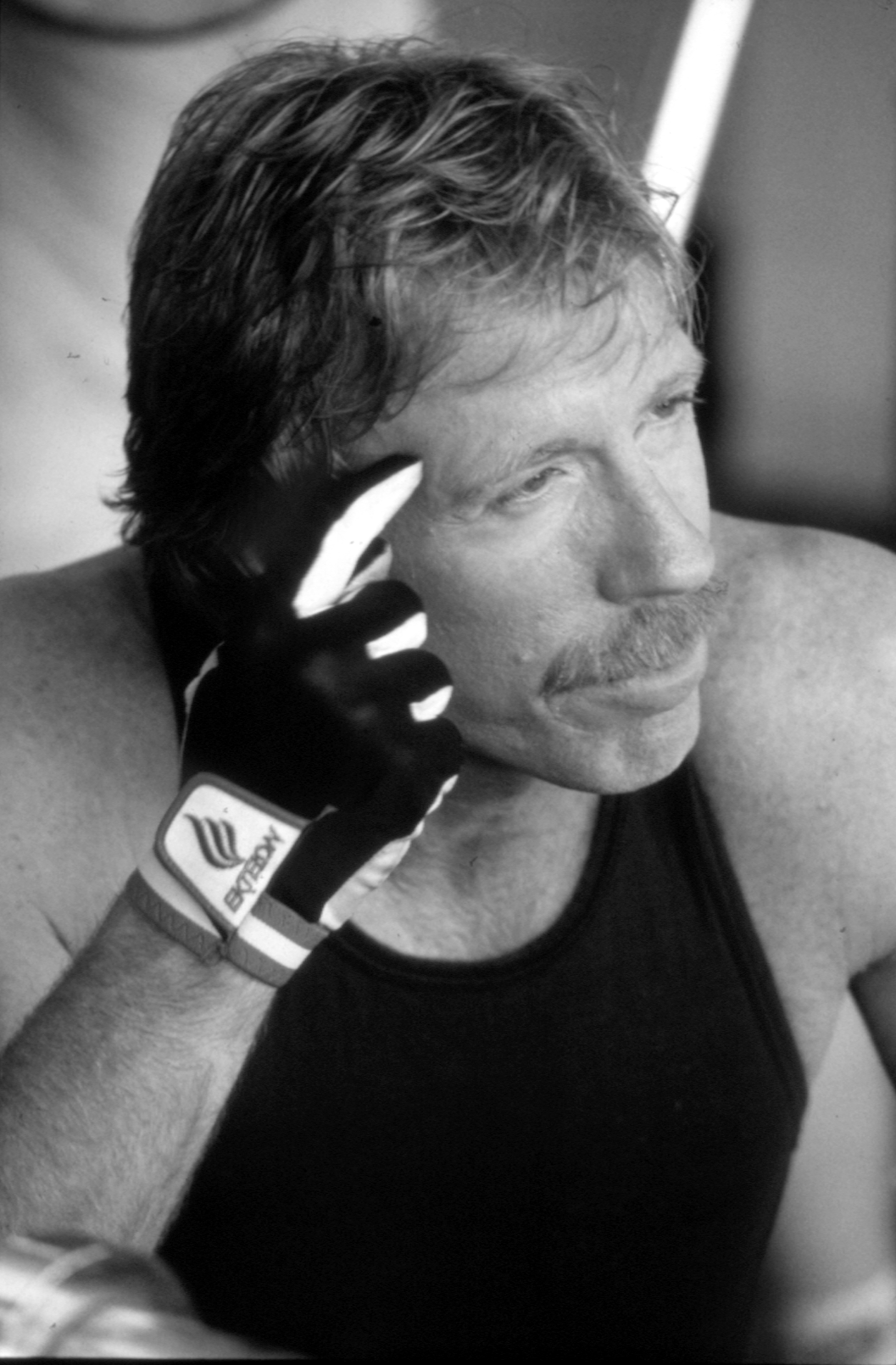
Did you ever feel weight training was hurting your martial arts techniques?
Never. It made me stronger. Weights won’t hurt your martial arts as long as you maintain your flexibility. If you maintain your stretching you can get much stronger and faster. But you have to stretch daily.
What has been the key to your success?
Determination and perseverance. You have to really believe in yourself to overcome all the obstacles that are going to be in your way because you can’t avoid them. What makes you win or lose is your determination to overcome obstacles. I keep looking at myself in the mirror and thinking about where I came from and what I was able to do. To me, life is there to be able to have the excitement of accomplishing new things.
How was you relationship with Bruce Lee?
We were pretty good friends. We used to work out together. But I don’t understand why people keep comparing us. My reputation came from fighting in tournaments and his came from The Green Hornet television series.
How were you training sessions?
We never got competitive on a physical level. He used to show me things that he was using as close-in counters, and I showed him my kicking techniques. We were very different physically speaking. He was small-boned and very thin. He trained with weights and put some weight on. I’m a little bigger-boned so our way of fighting was different.
What would be your last will for your students?
Physical training is only a vehicle to strengthen us mentally so we can develop character. If we don’t respect ourselves, no one will. I would tell my students that martial arts are an avenue for us to grow in all areas of life. Martial arts are the best avenue for gaining personal respect.
You have an anti-drug and anti-gang program. Why did you decided to start it?
Kids are the future. Do I need to say anything else?