Loading... Please wait...
- Call us on Phone 213.936.5599
- Gift Certificates
- Wish Lists
- My Account
- 0.00

Categories
FUMIO DEMURA - NUNCHAKU TRAINING
Posted by Fumio Demura on Dec 8th 2016
NUCHAKU & BRUCE LEE
by Fumio Demura
My good friend and Martial Arts icon, Bruce Lee, was responsible for bringing the nunchaku into the spotlight. He used it in his movies as a new “attraction” for the viewers, and his skills were second to none. Although popularized by Bruce Lee, the forerunner of the nunchaku was an instrument used as a bit for horses; it was not used as a weapon until later on when Okinawan farmers converted farm implements into protective devices.
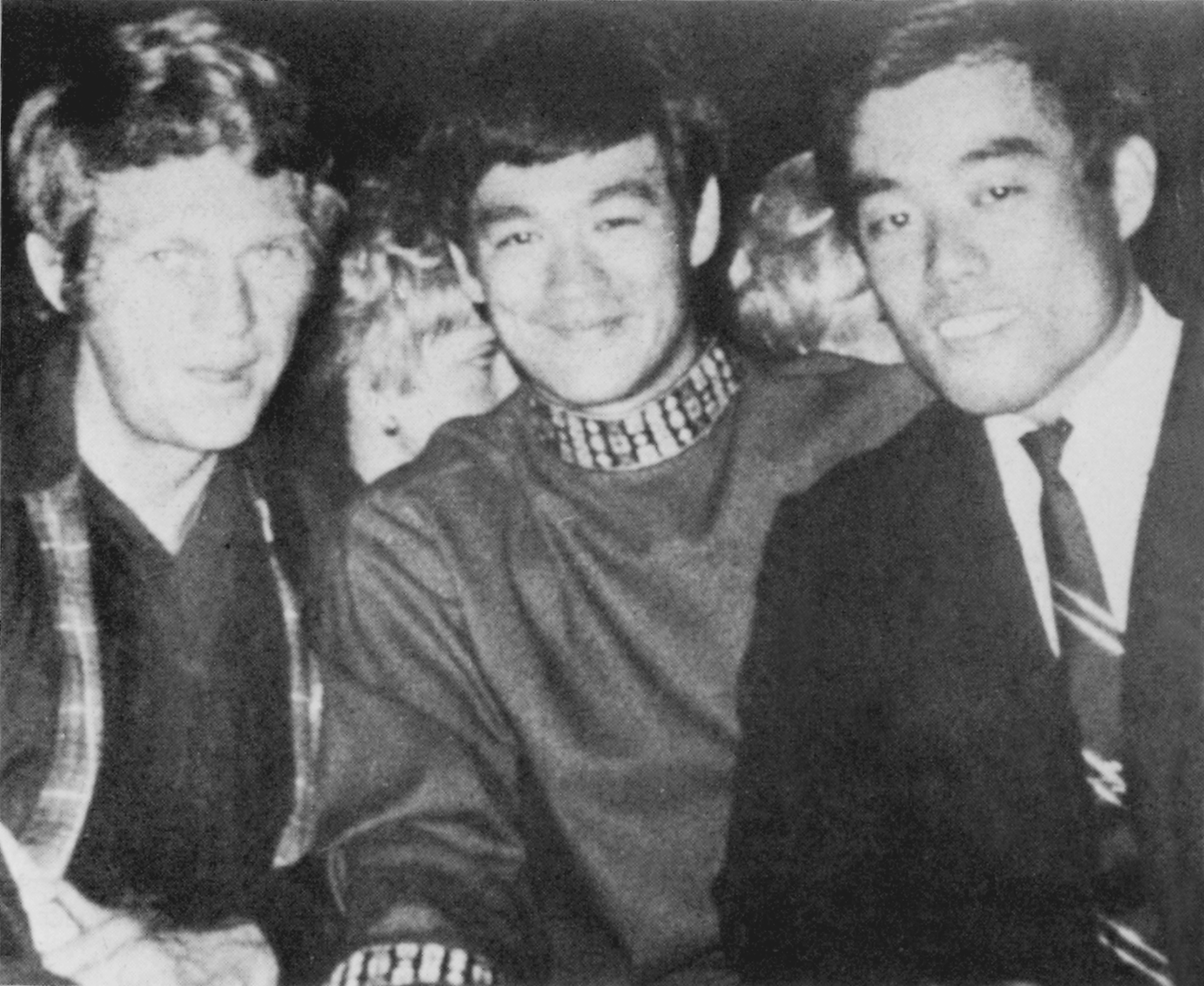
This weapon was constructed of two hardwood sticks connected by a rope braided from horses’ tails. Because of its simple appearance, the nunchaku easily was mistaken for a harmless bundle of two sticks. The Okinawan karateka saw the efficiency of this tool as a protective weapon and immediately incorporated into their arsenal.
The length of the nunchaku should equal the distance from the middle of the hand to the elbow, but it also should be adjusted to fit the practitioner’s height and arm power. The weapon is divided into seven different parts:
- The rope/chain (Himo or Kusari).
- Top (Kontoh).
- Hole (Ana).
- Upper Area (Jokon).
- Middle Area (Chukon).
- Lower Area (Kikon).
- Botom Area (Kontei).
Every part of the nunchaku can be used as a weapon and has a certain utility. For instance, the bottom and top can be used to jab or spear, the middle area is used to block and control in close-quarter range, and the rope or chain is very practical to pinch or choke the opponent.
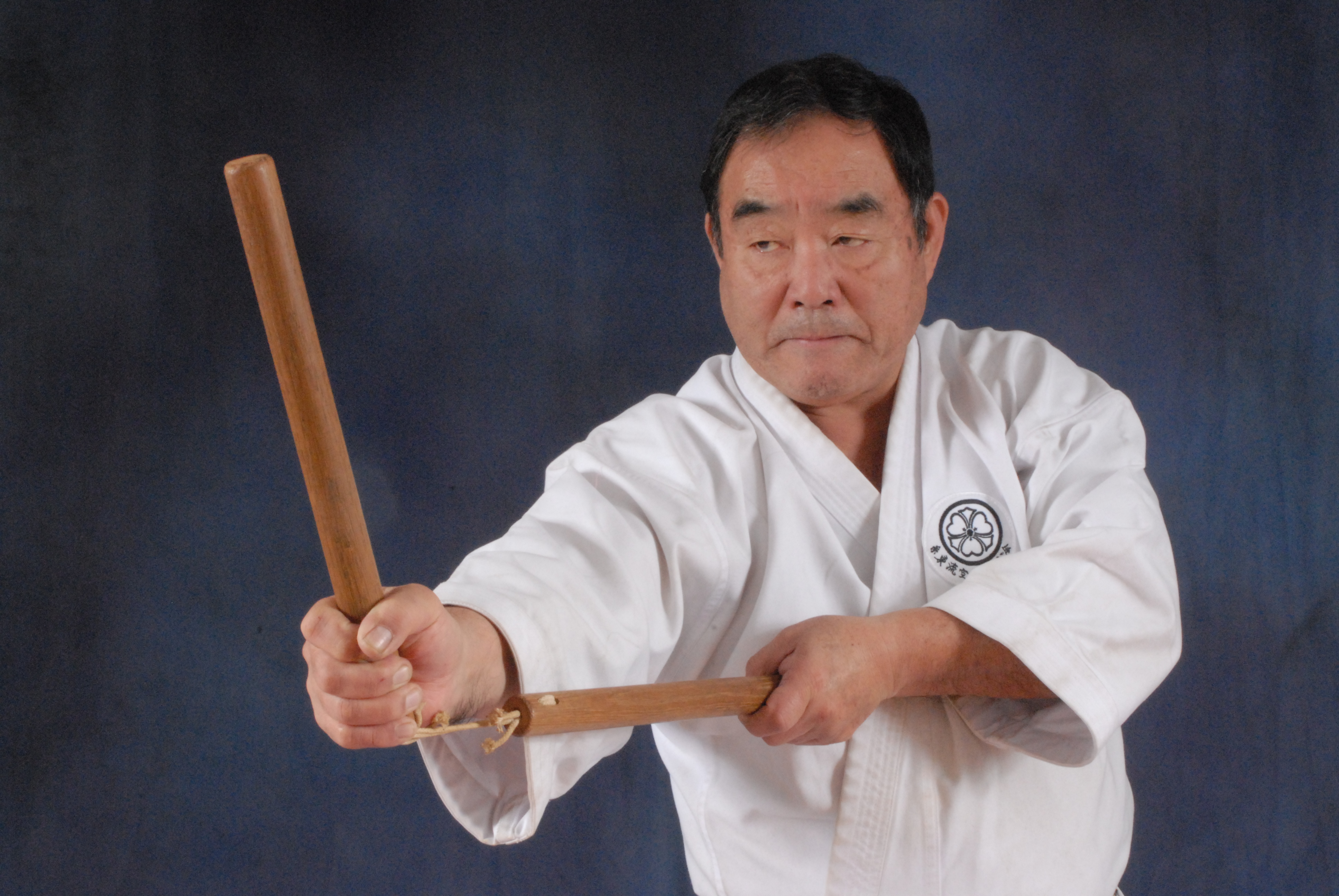
When analyzing the different designs of the weapon, we will find out that there are many different “shapes” used for the nunchaku. The main categories are: a) Maru-gata (Round); b) Hakakukei (Octagonal); c) So-setsu-kon (Long and Short); d) Han-kei (Half-size); e) San-setsu-kon (Three Piece Nunchaku); and f) Yon-setsu-kon (Four Piece).
The grasping methods are simple but they require diligent training and practice. The weapon can be grasped at the bottom, the middle area, and the top, and these grasping methods can be combined and altered on both sides, which gives us several possibilities of maneuvering the nunchaku. The possibility of changing grasps and gripping methods during the action provides this weapon with great versatility and a high degree of deception for our opponent. Although the basic grasping-change action involves two hands, it is the true mark of a master to change grips with one hand while using the nunchaku to attack or defend.
Due to its nature, the nunchaku is mainly a swinging weapon and this dictates the type of defensive and attacking actions that we can do in combat. The “snapping” techniques allow for a faster recovery to the on-guard position but the swinging actions are more difficult to control specially after hitting the target. Constant practice should be allocated in the training time to learn how to recover the weapon; the idea is to hit the target and recover the weapon safely so we can use it again. The recovery action in the most important technique for a Kobudo practitioner when using this weapon.
We can state that all the techniques developed for the use of nunchaku are self-defense oriented. Please do not mistake the “flashy” and “attractive” swinging actions that you can see in movies and TV with the “real” use of this weapon for self-protection. Once you understand the use and essential principles of the nunchaku, you will be able of developing a limitless amount of efficient and practical techniques.
To lear mora about the training of Nunchaku:
http://martialartsdigital.com/fumio-demura-kobudo-...