 Loading... Please wait...
- Call us on Phone 213.936.5599
- Gift Certificates
- Wish Lists
- My Account
- 0.00

Categories
YOSHIMI INOUE
Posted by By Jose M. Fraguas on Oct 13th 2016
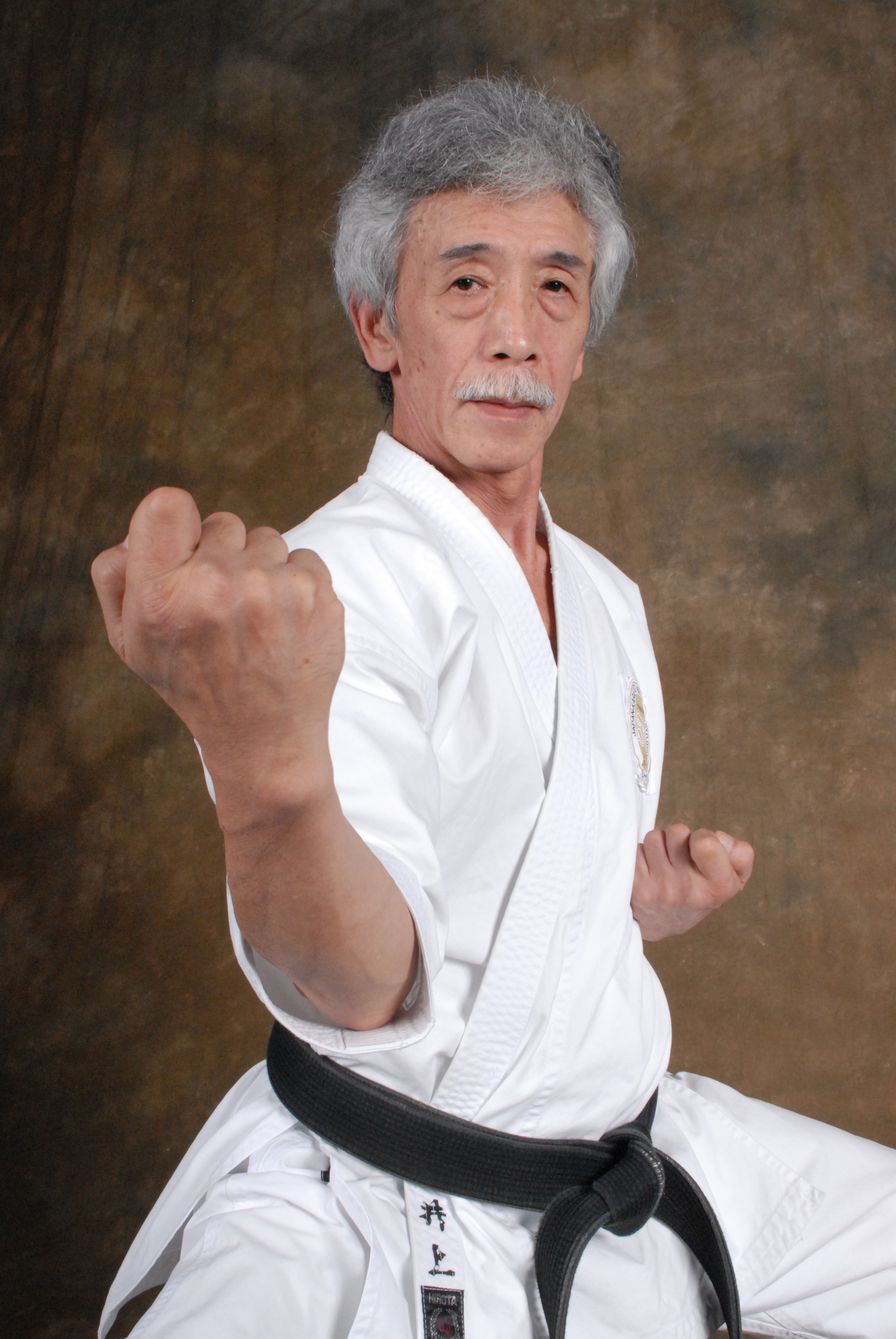
Many think that the power comes from the hip but studies proved different. What can you tell us about this?
It is true that people say that the power in Karate “comes from the hip.” Let’s start using the words correctly. Power comes from the ground up. It doesn’t come or originate from the hip. This is pure physics. A Karate punch [or kick] does not begin with the hip rotation. It passes cleanly through the hips into the torso, but it are not the hips that cause the power or the turn. The power that starts/originates or comes from the ground is transmitted to the upper body [and eventually to the punch or kick] by the correct use of the hip and then directed to the target via the arm or the leg. Our hips will impede the progress of the leg force/thrust if we don’t know how to open them loosely as pivot points. Why the legs? Because if you have no base, you have no power. Once again, pure physics. Your connection with the ground is the base for the power. Studies have been made in universities where professional boxers and karateka have been placed in the air hanging, with no base or contact to the ground whatsoever. The result? Their punching power was gone, decreased to the simple arm power. Why? Because they had no base. Those studies proved that the power originates from the ground up, not from the hips. It is impossible to deliver a powerful punch without a strong stance to launch it from, as you cannot use the rotation of your hips without being rooted to the ground. This is the right way to express it. What is important to the body mass and the way the hip is used.
Body mass?
Yes. The real driver behind power in any punch or kick is the amount of mass
behind the movement and the direction of that mass. Check all the physics
equations for force, momentum, and impulse. The way to maximize the amount of
mass behind your attack is to get as much of your body moving in the direction
of your attack as possible.
So what is the role of the hip?
As I said, the hip is the transmitter of the power that originates from the ground and from your “rooted” stance. Hip rotation is an accelerator that adds speed, and of course, increasing the speed of your body mass will increase the amount of power. But hip rotation is only one way of increasing the speed of your body mass and never is a substitute for proper application of your body mass to your techniques – which involves the whole body. You alos need to know how to use the counter-rotation of the joint and when to use it properly. Hips are where the body's center of gravity is located; our center point of mass is at the hip level and we should learn how to use our hips to increase velocity of the body mass – not necessarily speed. The right use of the hips helps to keep posture, balance, and stability for every move, but at the same time, being used incorrectly may shut off the powerful thrust of the legs. Hip rotation – not hip shifting – is used for adding speed to the body mass and therefore develop maximum power in karate techniques. That is why we say that in karate we always try to punch with the hips and kick with the hips, etc.
One more thing, the hips can’t generate power. Power is generated by the muscles around the hip. Two of the largest muscle groups in the body are the buttocks and the abdominal muscles; therefore, utilizing their strength, as well as rotating or shifting the hips, will add power to any techniques. As the hips turn, the torso and buttocks are added to the force of the technique. The hips are part of the bone/skeletal structure. A bone does not generate power …. muscles do. The real power comes from the buttock and the abdomen muscles. But a tight hip with no flexibility will decrease the potential power that you can use from your body mass and technique.
What about hip shifting?
What is the difference from hip rotating?
These are two different things and should be used in different ways. Shifting
is the movement of the entire body from one point to another in a straight
line. Shifting includes both stepping and sliding the feet. And this is how the
hips should be used because if you don’t move, you simply can’t hit your
opponent. So shifting your hips is the real key.
Shifting the hips and not rotating the hips is the method which allows the karate-ka to develop the greatest amount of force. This is possible because we use the maximum amount of body mass by using the legs driving against the floor [origin of the power] to push forward against the hips.
The rotation is developed by the circular motion of the body mass. Control of rotation is centered on the use of the hips. The outside hip joint moves forward and backward, while the inside hip acts as a hinge. This can be practiced without technique, and then with techniques added. It is very important that the knees remain locked in place without moving. The pivot point in hip rotation changes depending upon the situation. It is always either one hip joint or the other, never the center of the body. Rotating on the center of the body would mean that one leg is retreating while the other is moving forward, eliminating the effect of the rotation. With the use of hip rotation, it is possible to create very powerful techniques in a small space.
Another important aspect is to fully understand the hip rotation around a central axis and the application of the hip shifting in the same motion. This is a completely different concept and a more realistic way of using body torque to use the technique effectively. One aspect we should be aware of is that different styles tend to use or move the hips differently, although they are based on the same principles. Shotokan uses a very “wide” application of hanmi and shomen and Shito Ryu, Goju, and Wado use the same principle but with more emphasis on shifting.