 Loading... Please wait...
- Call us on Phone 213.936.5599
- Gift Certificates
- Wish Lists
- My Account
- 0.00

Categories
Dan Inosanto – The Eternal Master and the Forever Student
Posted by Jose M. Fraguas on Nov 27th 2016
Dan Inosanto
The Eternal Master and the Forever Student
HAPPY BIRTHDAY SI GUNG BRUCE LEE
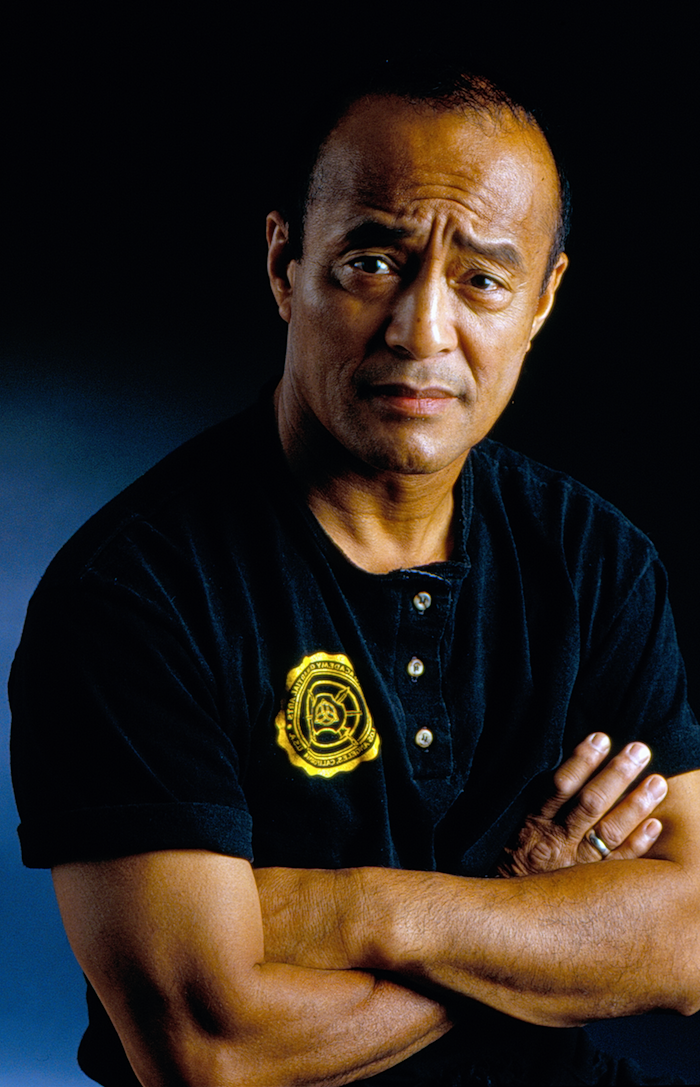
He is the master every student wants to be, and the student every master would like to have. One of the three men chosen by Bruce Lee to carry on the art of jeet kune do, Dan Inosanto was originally a kenpo karate student and Ed Parker’s assistant instructor and top black belt. Inosanto met Bruce Lee in 1964 and he became his student and personal training partner after a long conversation where Lee explained art and philosophy to Dan. Appointed by Bruce Lee as the instructor at his Los Angeles, Chinatown kwoon, Inosanto also did extensive research into the Filipino martial arts, becoming one of the most outstanding FMA scholars and instructors in the world. Inosanto’s many activities have also included writing a variety of books on jeet kune do and the Filipino martial arts.
Inosanto’s ever-growing learning desire led him to study under the most important teacher in the American martial arts scene, including Ed Parker, Bruce Lee, Ark Wong, Leo Giron, Ben Largusa, Paul de Thouars, Herman Suwanda, Edgar Sulite, Wally Jay, Gene LeBell, and many more. He searched out and studied under the most famous martial artist of all time.
His philosophy of using the instructor’s wisdom to achieve further heights in the martial arts is what makes Dan Inosanto one of a kind, and his academy the meeting point for practitioners of all styles from over the world. Simply said, Daniel A. Inosanto is the master every student wants to be, and the student that every master would like to have.
Do you consider martial arts violent?
Many people look at the martial arts as a sign of violence. The goal of a good martial artist is to preserve life, not to destroy it. All the training in the world can’t make you secure from every form of violence so the objective is to train the body to be able to preserve your life and the lives of your loved ones. Martial arts can bring people together and it is a very interesting way to educate ourselves about different cultures. Of course, the reason why you practice martial arts at 50 are different from what motivated you to begin training when you were 20.
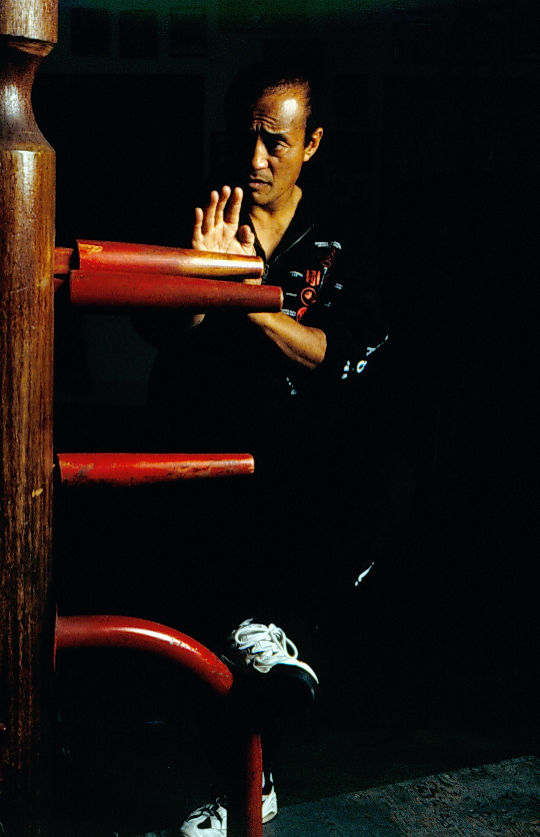 Do you think there is
a single “best” style?
Do you think there is
a single “best” style?
I don’t think so and I’ll explain why. Some styles are efficient at a certain range of combat. Some look very impressive and you think right away they are devastating. Others don’t look that impressive but they are very practical but you won’t realize it until you’re in the receiving end of one of their techniques. You have to find out if the style really fits your body type, which is very important. Some systems require a great deal of practice before you can effectively use them. Other styles can make you a very strong fighter in six months. In short, there isn’t anything close to a “best style.” You have to find what is best for you.
What kind of advise would you give to students?
I would recommend that if they have the time and the money, try and cross-train in as many styles as possible so you can get a deep understanding of different fighting forms and cultures.
Don’t you think this can be very confusing for the student?
Don’t misunderstand me. I don’t mean the student has to jump from one system to another. First he needs what I call the “base” system. He needs years of training and understanding in this base system because it is from there that he will evolve. So he needs a strong foundation. This foundation is going to provide his building blocks.
You mentioned once that you like to be a student every chance you get. Why?
I believe that in order to be a good teacher you have to be open to new learning. I don’t have any ego problems in becoming a student. Everybody feels awkward or clumsy the first time. You can get the best kickboxer in the world, and put him on the ground against a wrestler, and he’s going to be like a kid – or vice versa. I realized that only when you put yourself in what I call an “insecurity position” can you really learn something. And when you learn something you get better. I don’t mind being a student in savate, or Thai boxing, or wrestling. In fact I really like to be in that position. It probably has something to do with my personality. You need experiences to grow, and it’s important for an instructor to remain a student in order to constantly seek better ways of training and teaching.
Do you think experience is the best teacher?
If not the best, then definitely one of the best. But having experiences without the understanding to evaluate and learn from them is not good. You have be able to understand your experiences – this is where knowledge takes place.
Is that why you like to give experiences to your students?
Right. If the student really wants to learn he will, despite the method or the system that the teacher is using. If the student doesn’t want to learn, there’s nothing the teacher can do. No matter how well the instructor can impart the knowledge, it’s up to the student to have the desire to learn. This is the reason why every instructor has very good and very bad students. Some students only need to hear “Hands up!” one time, and they won’t drop them again. For others, you have to correct that point class after class, for years and years, and they will still drop the hands!
You advocate change. What kind of change do you mean?
I think that a better word would be “adaptation” or “evolution.” I don’t think the term “change” is totally understood in martial arts because it gives the notion that you’re changing styles all the time, when you’re not. Let’s say that I’m a boxer and I know nothing about kicking. If I have to face a kicker, some of the boxing aspects have to be slightly modified to deal with those kicks. The head can’t lean forward, the block has to be adjusted to protect my face, et cetera. I’m not 'changing styles, but rather adapting my system.
If I face a fighter that likes to kick to the legs, like a Thai boxer or a savate man, I need to learn the technical knowledge for blocking those kicks. Otherwise, I’m going to get in trouble. So my defensive structure starts to be a little bit different because my weight distribution has to be different than the on-guard position that I was using in boxing – which would make my front leg very vulnerable. Of course, knowing how to kick will raise my offensive level and my attacking possibilities. I may still prefer my boxing hands to finish the fights, but I still need to adapt according to the opponent. We can introduce wrestling and groundwork into this, making the complete equation even more complex. But the whole idea is that the more you know, the better prepared you are.
I’ve always believed that learning was a process of accumulating knowledge. Sometimes the knowledge is not just a physical technique, but rather the understanding you get from the experience of training in other systems by learning their techniques and tactical approaches. As a fighter you can learn ten different ways of blocking a kick to your legs, and after many hours of sparring and trial-and-error, you might decide to use only two for your fights. The opponent may know your two techniques, and some people may think that this makes you predictable – but that’s wrong. If you know how to use the tactics and the rhythm and timing with only two techniques, you can be very unpredictable in combat. But if you’re an instructor you have to be very careful to never discard any knowledge because what may be useful for you (the two ways of blocking the low kicks) may not be useful for your students. So you have the responsibility to giving to the students the ten techniques for blocking the low kick and let them, through experiences in sparring, decide which are the best for them. Knowledge is relative to the user and the practitioner. To understand certain experiences you need to have previously accumulated knowledge.
So trial and error is the key to learning?
For me it is. I introduced Bruce to the foam football shield and kicking shield around 1964. He rejected its usage because at that time he preferred to train solely on the heavy bag. I told him to experiment and work with it for a while, and after two weeks he fell in love with it. He even developed drills that he modified or changed as he got more familiar and learned more about it’s usage. Let’s take football. The difference between a rookie and a veteran is experience. A veteran is more knowledgeable than a rookie. His knowledge come from previously accumulated learning experiences. It is true that every moment is different, but one can better cope with a situation if he has the knowledge to flow from moment to moment. Only after you had many experiences can you “chisel away” the many nonessentials.
Do we have to accumulate knowledge then?
We have to be inspired by the previously accumulated knowledge and not to be bound by that previous knowledge – which is very different. That’s why I encourage my students to study and look into other systems and instructors. No art, person or system is better than any other. It’s important to understand not what is right in general, but what is right for the moment.
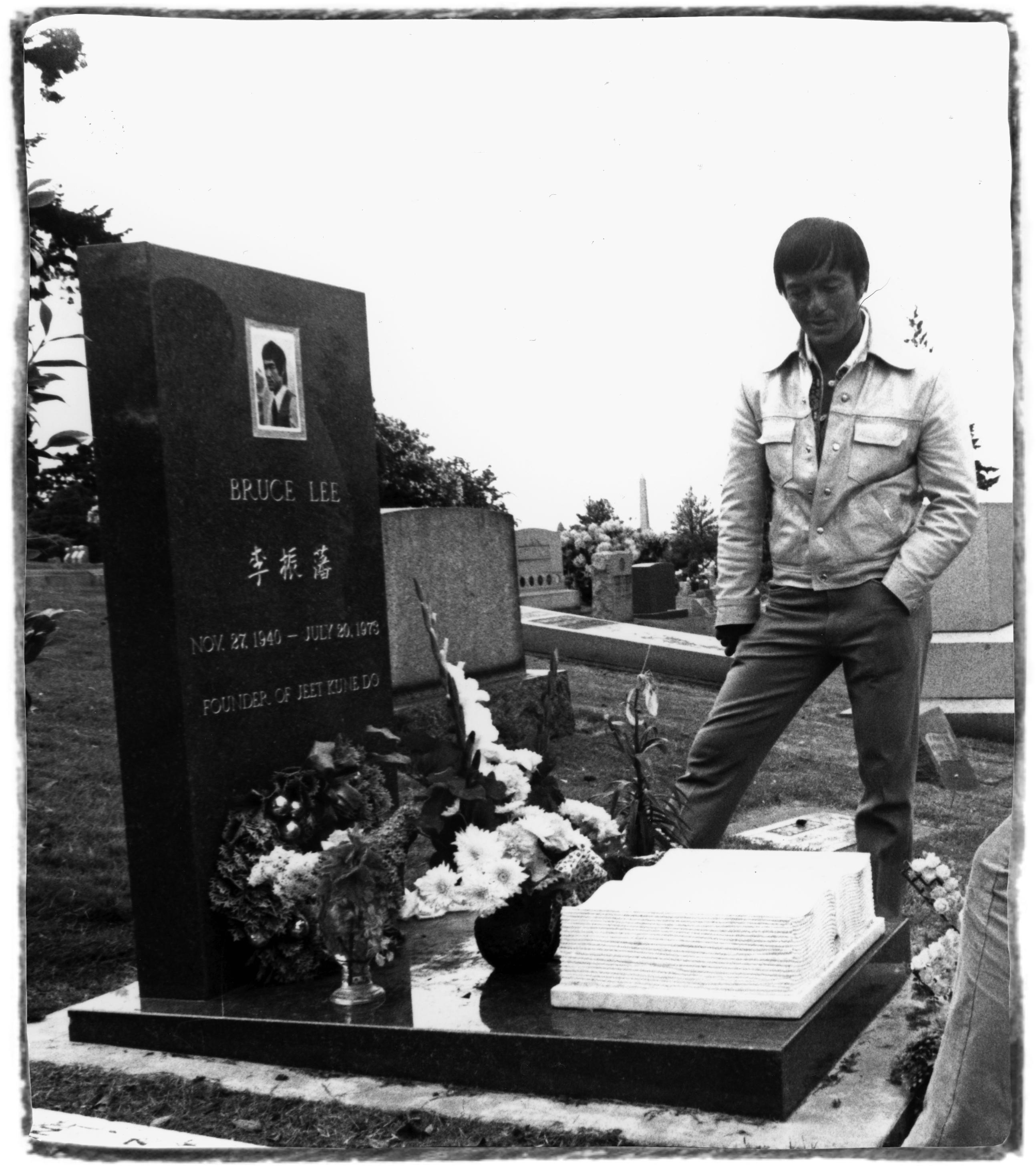
How important is it to know yourself, in your martial arts philosophy?
I think is paramount. Only you can answer certain questions – not your instructor, or your sifu – but only you. To understand yourself is the very beginning of the self-discovery process. If you lack of understanding about yourself, you become an ignorant, second-hand martial artist because you are the one in charge of expressing yourself and making the art work. And the only way you can do this is by being an expert on yourself.
You mentioned that teaching martial arts is a two-way street. Why?
Because good instructors produce good students and good students help the instructors to be better. Instructors should realize that everyone has his own path – that’s why I would rather be a pointer to the truth than a giver of the truth. The teacher has to understand that the student will find his own way when he’s ready. In fact, that’s what the very essence of the JKD philosophy is all about.
What do you think about forms?
I have to say that Bruce was not anti-form and neither am I. Forms or katas are a way to learning proper body mechanics. Forms can be a part of your training, but your entire training shouldn’t be based on them. They can be useful to structure certain knowledge so you can preserve it, but once you understand it you should freelance. You don’t have to follow any particular sequence – you can flow. But as far as teaching is concerned, the instructor needs to have a format, a structure, and a technical progression in order to pass-on knowledge – even if later he discards that structure and mixes the material. The key is not to be bound by the form, but to learn from the form.
Some people might ask why Dan Inosanto is still seeking knowledge for other instructors if he personally trained with Bruce Lee? Wasn’t Bruce Lee enough?
Bruce was a very knowledgeable and talented teacher –especially on one-on-one – but no one man has it all. Bruce himself went to study and research under different people because he realized that principle a long time ago. It is true that I do it more openly, perhaps due to my own personality. But make no mistake, Bruce wanted to liberate his students. He wanted no one to take his advice as gospel.
What are your personal goals as a martial artist and as a teacher?
I’d like to see my students develop themselves. They will take the arts in many different directions and that’s fine as long as they don’t insist that their way is the only way. A good martial arts instructor can be a combination of many things – from a guide and father figure, to a close friend and counselor. A truly good instructor may well be worth more that he could ever be paid, because there is not enough money to pay those who are so relevant to the development of your character, education, and confidence. My goal is to create a standard of excellence for all the martial art, regardless of origin, and to perpetuate the art and philosophy of Bruce Lee’s Jeet Kune Do.
To learn more about Master Dan Inosanto and the art of Jeet Kune Do, click on the book image!
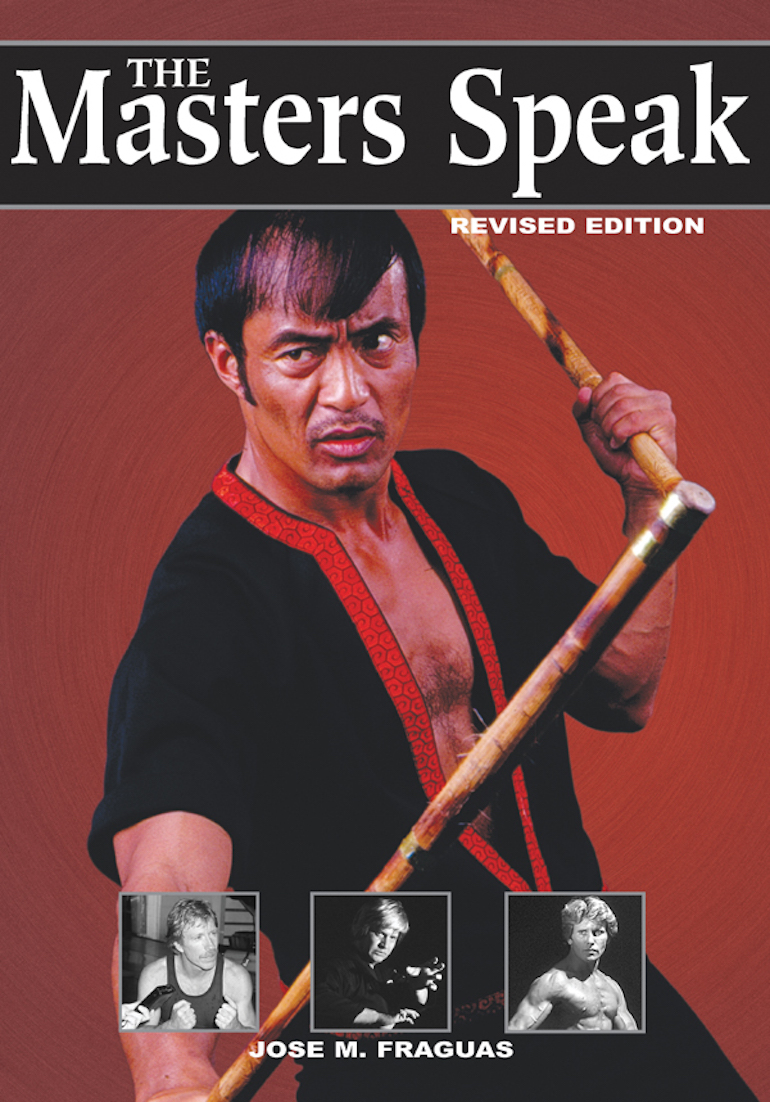
http://martialartsdigital.com/the-masters-speak/